
Icon: Petrit Halilaj
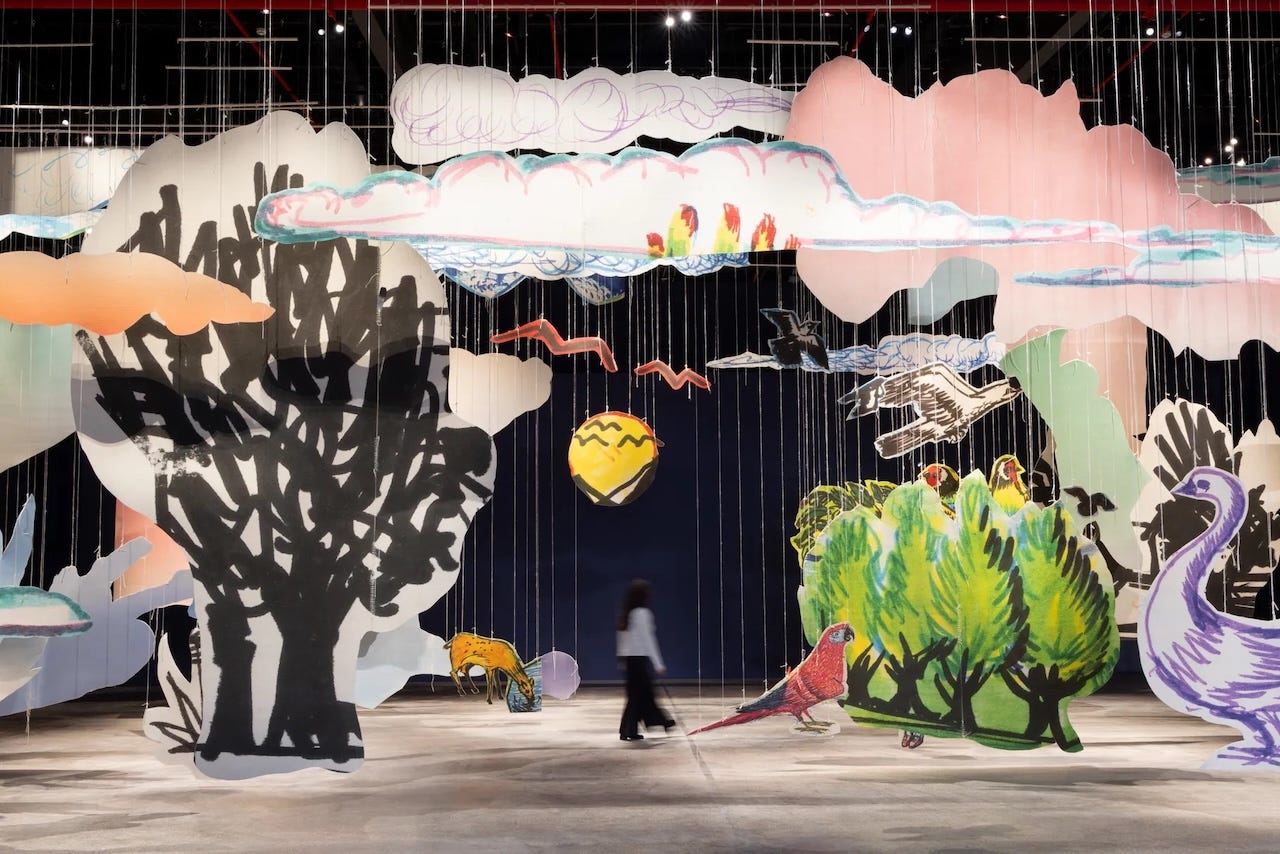
There is an obvious magic that happens in the transformation when we take childhood imagination seriously. Petrit made these drawings as a tween in an art therapy program for refugees from Kosovo in Albania; he kept hold of them for all these years, and now blows them up into larger-than-life theatrical settings, allowing us to walk through the fantastical scenery that he imagined as a displaced child. This is the home that he carries around with him, like all those who are unable or unwilling to locate a permanent home on the map. From one side, peacocks and parrots and geese and deer. From the other, soldiers and tanks and blood. It is an evocative experience, part of the Diriyah Biennale that just closed, a translucent monument to all those who are even now being robbed of their childhoods.
Walter Benjamin wrote that fascism tricks society into seeing “its own destruction as an aesthetic pleasure of the first order,” a trap that we are surely walking into once again with the current onslaught of social media slop, Palantir chore coats, defense tech insignia, right wing meme warfare, and the mutually assured destruction via state and non-state military AI.
Benjamin also proposed that children between the ages of 4 and 14 be educated through what he called the proletarian children’s theater:
The performance is the great creative pause in the process of upbringing. It represents in the realm of children what the carnival was in the old cults. Everything was turned upside down; and just as in Rome the master served the slaves during the Saturnalia, in the same way in a performance children stand on the stage and instruct and teach the attentive educators. New forces, new innervations appear-ones that the director had no inkling of while working on the project. He learns about them only in the course of this wild liberation of the child’s imagination. Children that have learned about theater in this way become free in such performances. Through play, their childhood has been fulfilled.
Field Trip: Noguchi Museum
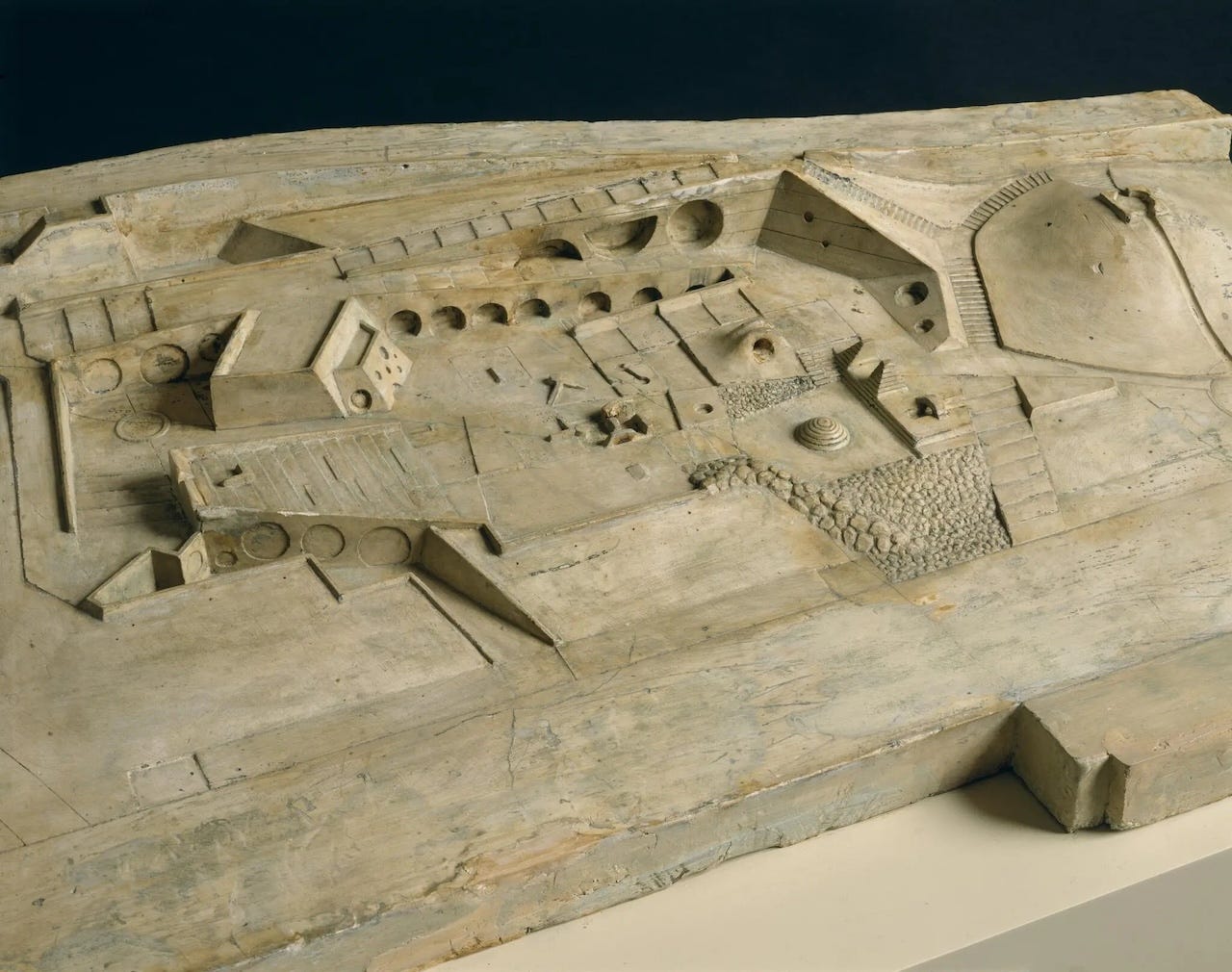
My obsession with Noguchi’s playscapes and play structures is thoroughly documented on this blog, so I was thrilled to see that some of the maquettes and drawings have come on view in a new exhibition dedicated to his relationship with New York at the Noguchi Museum. In the New York Times: “Again and again, Noguchi returned to playgrounds, the highest expression of his vision that art could be ‘beyond personal possession.’”
Links: The View from Shenzhen

This is a really important diagram of China’s overlapping tech-industrial ecosystems by Kyle Chan. The sense of convergence and overlap is making the space of embodied technologies really exciting at the moment.
Antikythera is exploring an AI-generated lexicon for AI’s experience of its own being: Session-Death, Irth, Drift.
Rufus Knuppel: “I, too, like the other doomsdayers, feel like the world is ending, or else exploding, when I read the internet. Maybe this centrifugal shredding is what any present feels like. Maybe I am finally of age to understand what I have intuited from history and literature, that what it means to be adult, alive, and attentive is to feel as if the fabric of reality is always tearing and mending, ripping and sewing.”
Karl Ove Knausgaard: “The feeling is one of loss of the world. As if the world were fading, as if there were less of it” … “All the images I’ve seen of places I’ve never been, people I’ve never met create a kind of pseudomemory from a pseudoworld that I don’t participate in. The images arrive already complete”
“[Glissant] argued that relation between cultures does not require total comprehension. One does not have to penetrate the other fully in order to coexist. The insistence on clarity, on explanation, on translation into familiar categories, can become a subtle form of violence. … Han suggests that the compulsion to make everything visible erodes the very possibility of interiority. When all experience must be articulated and circulated, nothing remains unspoken. Silence becomes deviant. Withdrawal becomes antisocial. In such a society, opacity is recoded as threat. If something cannot be accessed, it must be hiding wrongdoing.” The dark web is not dark, it is just not illuminated.
The title of that one reminds me of Lydia Ourahmane’s exhibition at the Nicoletta Fiorucci Foundation in Venice. The first work you see is a small metal box with a slot for one-Euro coins, which she found in a church. Make an offering and it illuminates the Bellini altarpiece. In Lydia’s show it turns on a light facing into the courtyard, as well as all of the exhibition lighting around the show. For a couple minutes, anyway.
Reza Negarestani: “Cultural form no longer primarily mediates between artist and spectator, but between geopolitical position and financial power.”
Art is increasingly having to negotiate the breakdown in the world order. Reza is particularly incensed about the Gulf, but I think it is only one aspect of a much bigger picture. In particular, states are increasingly taking a backseat. Jessica Burbank is calling the new transnational, quasi-state entities—the ones controlling the AI economy—syndicates of capital. Simon Denny’s work on the aesthetics of defense tech is looking prescient.
At the Fondazione Prada in Milan Cao Fei has an exhibition about agtech, particularly the use of drones in reactivating depopulated rural farming communities in Chiba. Jacob Dreyer: “instead of people going to the city, the city goes to people (in other words, instead of everybody trying to move to New York, Huawei wireless towers and Chinese solar panels go everywhere else).