

Icon: Sarah Sze
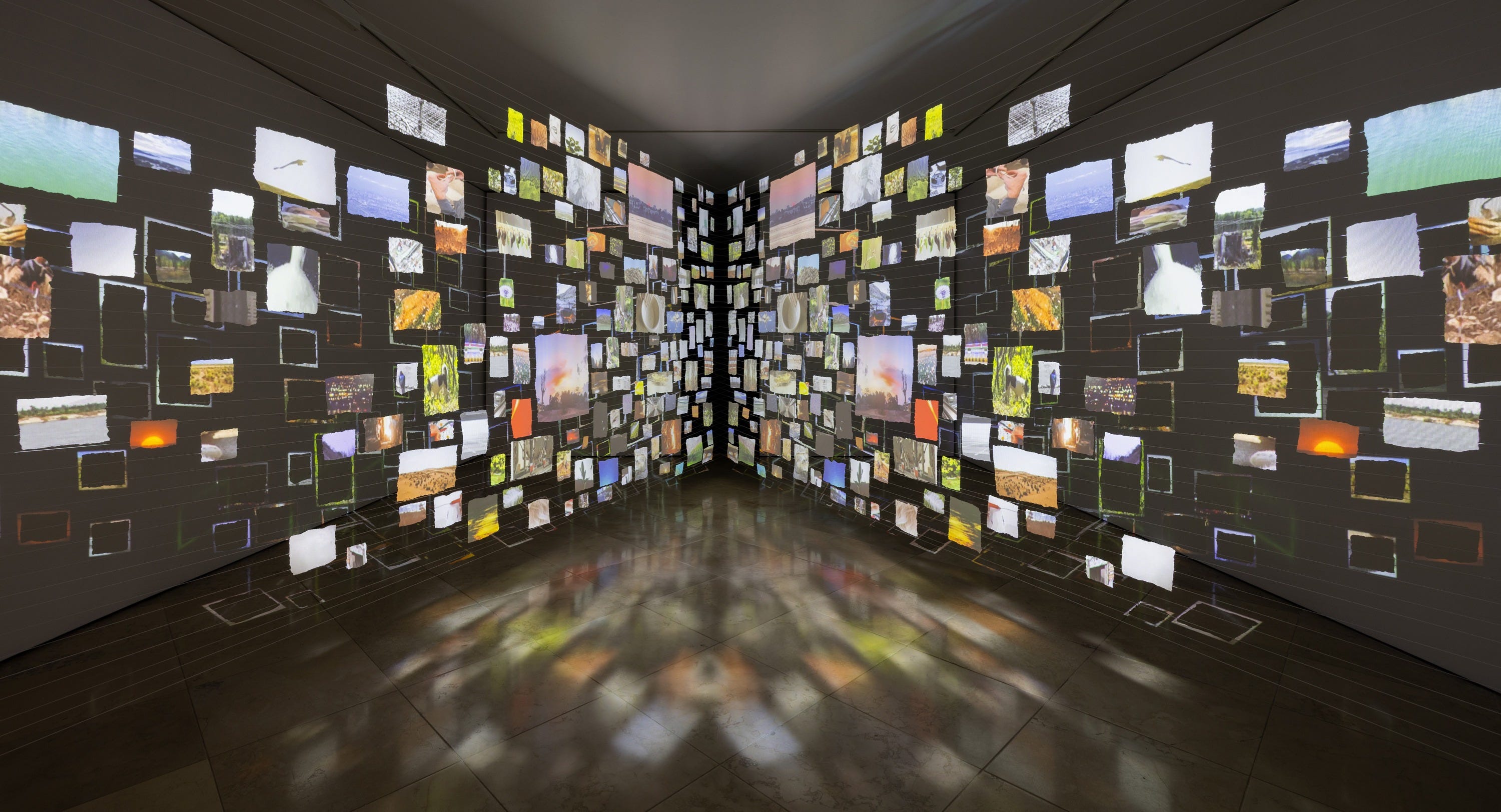
Early this year Sarah Sze’s incredible Sleepers made its way to LA. I saw this one two years ago in Venice, in the haunted brick and humidity of Victoria Miro’s canalside storefront, where it was endlessly captivating. Each fragment of screen—delicate card with rough edges—is suspended on a matrix of filament, the projection landing precisely on the face of each one so that they can function variously as parts of a greater whole or individual images. From the Guardian:
Sleepers is based around video recordings that Sze made of her two daughters while they slept. In part the installation is about what it’s like to be a mother, of watching time slip away as one’s daughters speedrun the accelerated experience that is childhood, and trying to grab on to those fleeting moments of calm and closeness that are a part of raising children. “There’s a kind of real intimacy and tenderness when you see someone else asleep,” said Sze. “Their vulnerability and your own inability to engage in what they’re engaged with. That idea of being there and being completely in a world that you can’t enter.”
Field Trip: Manet and Morisot
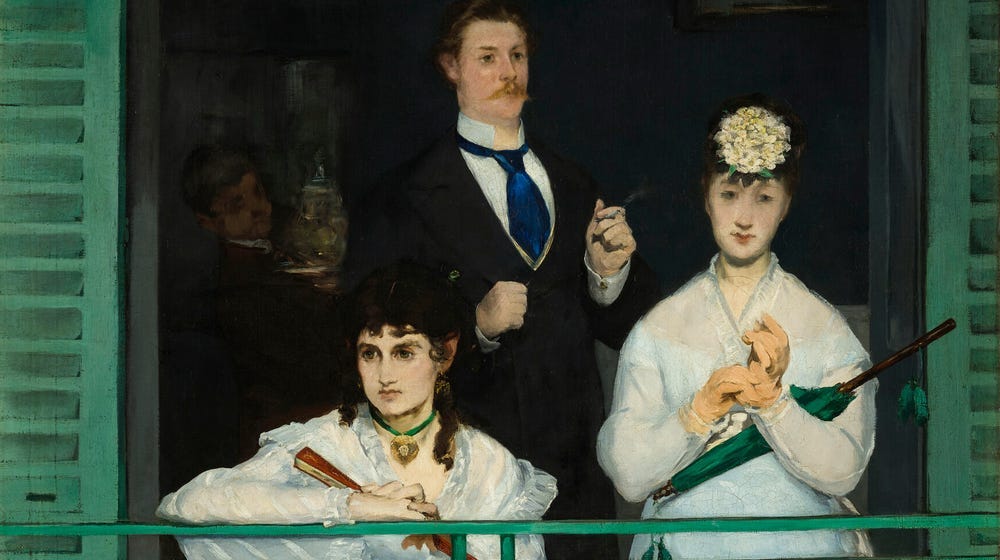
On critic Jason Farago’s Instagram I saw this brief note about an exhibition at the Fine Arts Museums of San Francisco:
Four seasons by two hands. Manet’s Spring (from the Getty), Morisot’s Summer (Musée Fabre), Manet’s Autumn (from Nancy, unfinished), Morisot’s Winter (Dallas): this not-quite-a-quartet of Parisiennes is united for the first time in “Manet and Morisot,” a show about a brother- and sister-in-law who each taught the other how to live a modern life. I’ve got complaints at the margins; I could sound off on what’s missing. But at its heart this is a show about modeling and marriage, and what we learn from friends and family: about how art, in alienating times, affirms we are never alone.
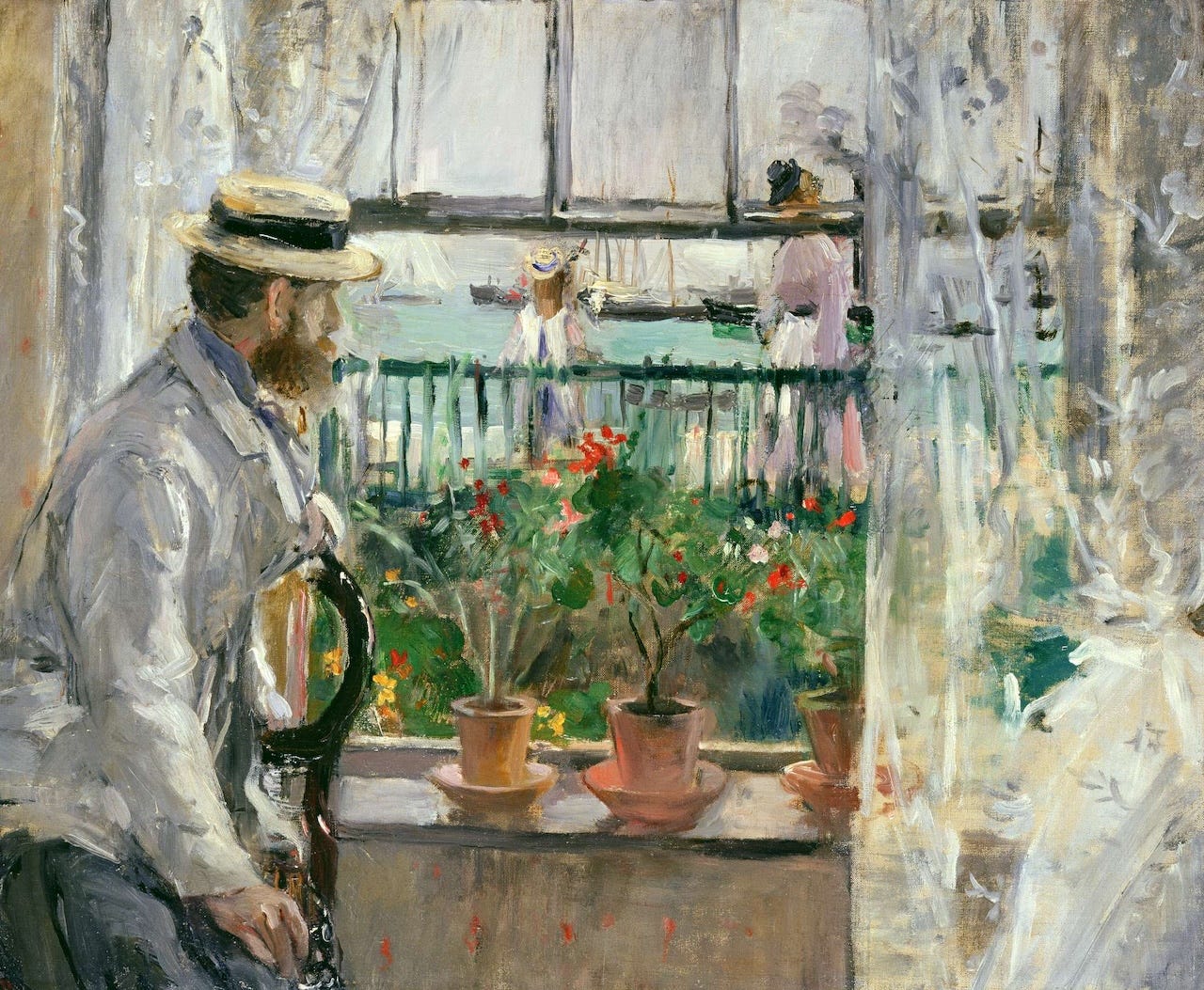
Jason is one of our sharpest living writers on art. In an older piece from the New York Times he wrote about Morisot’s paintings of the seaside with a keen eye for detail. He starts with an analysis of this painting of Morisot’s husband, Manet’s brother, on their honeymoon. His approach is perceptive, sneaking in a lesson on the history of the seaside as a holiday destination, and his close reading of the brushwork around the garden, the curtain, the window frame is enlightening.


At the heart of the composition is the triangulation of painter, husband, society, world; we see the social graph of the relationships that constitute the artist’s life. As the foremost female voice of impressionism, it is interesting to follow shifts in Morisot’s subject matter over time. The structure of the family, of the maternal gaze, appears here in a very specific way. On the right, that’s her sister as a new mother; on the left, that’s her daughter in morning for Eugene. A greyhound rather than a whippet this time, or so we’re told, but who’s to say?
Emily Beeny, curator of the exhibition in San Francisco, walks us through her scholarship in this lecture. Jason’s colleague Karen Rosenberg has the review here. She concludes with a portrait of Morisot by Manet early on in their friendship:
The museum goes so far as to call the work “uncannily reminiscent of self-portraiture,” underscoring that the key dynamic in this show isn’t romance, or even friendship, but something perhaps rarer: recognition.


The exhibition does the curatorial work not only of putting two artists side-by-side and demonstrating influence or comparing styles, but further in evaluating the relationship between them in both directions. Beeny points out that in Morisot’s self-portrait Before the Mirror, she depicts a Manet portrait of her that he had gifted her some decade earlier. You can see it in the upper left, reflected above her head from behind her. It reminds me a little bit of Matisse’s portrait of Meerson, destroyed because its patron found the affair unsavory—and yet immortalized within the Red Studio.
Homework: Tom Sachs
Tom Sachs is on a book tour promoting his new book, Tom Sachs Guide, and on a podcast guest spot he did I was reminded of his infamous line:
Creativity is the enemy.
The idea is that artists are no different from everyone else, and no one gets to rely on inspiration, talent, or genius. Day in day out, you show up and do the work, creating the conditions for the art to emerge.
Book Report: Transformative Experience
In the New Yorker there’s a long profile of L.A. Paul, a philosopher who writes on decision-making. The upshot of it is this:
We all consist of multiple selves who cannot be counted on to agree with one another across time.
We know that we are very bad at predicting how much we will enjoy or appreciate something in the future. From the philosopher’s perspective, this throws our whole account of how we make decisions into doubt. Should we maximize for the pleasure or happiness that our present selves would appreciate? Or try to guess what our future selves might find more compelling? On some level, the mind of a future self is as unknowable as the mind of a stranger in the present.
I’m posting this here because of the real-life experience that brought Paul to these philosophical dilemmas:
The question of whether to have a child was, for Paul, a sort of riddle that illuminated the limits of rationality.
Letter from the Atlantic


Over the Chinese new year holiday Coco and I spent a couple of days in the Somerset countryside. For the second consecutive holiday I left my driver’s license on my desk; we are now on excellent terms with the taxi drivers of Sifnos and Bruton, for anyone who happens to be looking. It turned out to be not entirely impossible without a car. We spent one misty morning walking from the pub to the farm shop, then back to the pub for lunch only to arrive just before the delivery of our cache of cheese and cider.


Our ramble along the hedgerows was bracketed on both sides by the London imagination of landscape. I walked to the train station through the park, passing by the split golden Giuseppe Penone tree that stands outside the Serpentine. And, back in town, a Mayfair gallery walk offered up paintings by both Georg Wilson and Rachel Rose, both of whom are working with the history of landscape painting, particularly around the legacies of enclosure in the British countryside. Georg’s paintings are delightful romps through the bocage, with trees and shrubs taking on humanesque forms and little semi-human creatures peeking out here and there. I would imagine her somehow akin to Jessie Buckley’s Agnes in Hamnet, a forest witch familiar with the medicinal uses of all of the poisonous herbs at her disposal. This is somehow key to the way landscape is working in art right now: it contains a darkness that is both knowledge and threat. Rachel’s paintings take a step back, more about how we see the landscape as it is filtered through history, through time, and through technology. The two small pieces we saw in Pilar Corrias’s viewing room gave off optical distortions of paintings (also from what might be called the enclosure era), visually engrossing effects that merge the materiality of the painting into the slickness of the image. I am often averse to contemporary reworkings of the classics but this is the rare case where her reinterpretations of certain details offer something new that was only implicit in the original.
Speaking of reworkings, Ryoji Ikeda’s weekend in residence at the Barbican took the form not of his familiar electronic sound and black-and-white binary visuals but rather a series of new music compositions for strings, percussion, and choir—entirely acoustic. It was unexpected; I found myself particularly interested in the visual aspects of each piece. In each movement of one work, a pair of violins or violas moved towards and past one another along either side of a mirrored score laid out horizontally across the stage like a scroll paintings. In another, the nine bows of Ensemble Modern traced peaks and valleys, coming together in moments of visual unison.


I also loved the sprawling group exhibition across the new Sadie Coles space, a slew of brilliant painters somehow tied to or inspired by the Oscar Wilde novella Lord Arthur Savile’s Crime. It was the perfect skeleton for a Savile Row townhouse. If I had to pick a favorite it would probably be Laura Owens, with a kinetic cut-out canvas that continues to complete itself. But Celia Paul, Ambera Wellmann, Joseph Yeager, Maggi Hambling—the orbit around the galleries is like picking up new postcards dropped by friends off in distant places.


One surprise came in the form of the Beuys bathtub at Ropac. It is a shocking and unsettling sculpture. There is a suggestion that it could be plumbed into a home, that it is engineered to heat the water inside it and the air around it simultaneously. In maquette it is fastened to a wooly mammoth tooth. It is a thing pulled out of history that nevertheless sits so heavily on the fabric of space-time that it pulls us into a rupture, a chasm of memory and experience and memories never experienced.


The other bracket to my February came in the shape of the Beijing power couple Hu Xiaoyuan and Qiu Xiaofei. Xiaoyuan had an exhibition of new sculpture at Stuart Shave’s new St James space, which as our last stop in the neighborhood was somehow a synthesis of these drifting thoughts on the landscape and the townhouse. Best known for her works that trace the grain in graphite on silk stretched over wood, for the last few years she has been pushing further into found natural objects and the constellations that they can constitute, including in outstanding presentations at Tai Kwun and the Shanghai Biennial that I have written about previously. They are at their strongest when they come with an aggressive level of cohesion and insist on a degree of confusion between what is natural and what is intervention. In London they sat beautifully in nested spirals of gauzy textile.


Prior to the holiday I found myself in New York, where Qiu Xiaofei was opening his first solo exhibition with Hauser & Wirth. It was an intensely personal exhibition, working through his father’s death. His relationship with his parents has been a source of resonant and productive friction for Qiu: I think that his biggest breakthrough came when he moved from thinking about his experiences as representative of his generation—arguably the happiest generation, experiencing both the golden era of stable socialism in childhood and the boom years as a young artist—and started mining the traumas and dramas that might be unique to him. This group of paintings is achingly good, unveiling death as a specter tucked away just beneath the surface in the anxieties of the everyday, in layers from the mythological to the intimate. Another nested spiral. It is a simple geometry, this exhibition, using four perimeter walls and a single additional wall in the center, but it creates a complex experience of circumambulation, something of a temple effect that asks you to walk round and round as if you were reading murals.


There was a lot of religion in New York: at Amant, Lu Yang built an altar. Of her two video installations, I noticed that people spend huge amounts of time with the one that is driven by AI graphics. I wonder if it’s the irrational speed of transitions, if the viewing experience mimics the TikTok modality of dopamine delivery that we have come to expect from visual culture. Mimosa Echard, just across the street, constructed another kind of cavern of devotion. I think her rooms are like paintings, each wall work a single brushstroke that lends itself to a broader composition. At PS1, Ayoung Kim’s sequence of video installations from her “Delivery Dancer” series is almost the perfect complement to Lu Yang: parallel universes, intersecting timelines, doppelgangers, speed and seduction. A fundamentally unknowable self that is thrust back at us in dangerous ways at unsuspecting moments.


At MoMA, Wifredo Lam’s long overdue retrospective leaned heavily on the Santeria angle. In Asia we have been talking about him for ages as a key missing link in the history of the twentieth century, a vector of radical mobility (like Zhang Daqian, from China to Brazil) that proves the plasticity of the ideas and ideologies in which art variously swam and drowned throughout those years. We also speak often of the archipelagic thinking of the Caribbean, which has a particular application to the intellectual life of Taiwan, so I was thrilled to see Lam’s collaboration with Aime Cesaire on view. Downstairs, Arthur Jafa built a little apse chapel, the great success of which was his pairing of a David Hammons tarp painting with a Hélio Oiticica “Bólide,” two universes in miniature that require the mind to imagine traveling into and through them but reject the body at the narthex.
Many things are looking spiritual to me right now because my life has unexpectedly become a bit more religious. My daughter, who has been a committed communist for the past two years, has become curious about the Eastern Orthodox church, and last week asked me to chaperone her first liturgy. I was shocked by two elements: first, the self-inflicted discomfort of standing in a shadowy, smoky room for three hours, and, second, all of the touching and kissing of the floor, the icons, the bible, the crucifix, the chalice, the priest.


My religion, of course, remains art. Nicolas Party offered one vision of the sublime with his recreations in miniature of past paintings, which have been rightfully much celebrated. And while these are wonderful and stunning in their own right, and demand a fine level of attention wherever they are encountered, whether here in series or alone in an art fair booth, it’s really about the throughline to the show, the titular “Dead Fish”: three paintings proceeding from a Goya still life, all in different materials and dimensions (pastel on linen, 44.93 x 62.71 cm; oil on copper, 15.56 x 17.78 cm; soft pastel on wall, 439.42 x 523.24). Party transcends the conversation around painting with the action of painting.


The other paintings that caught me were on opposite ends of the spectrum and opposite ends of Manhattan: Joan Semmel at the Jewish Museum, and Jia Yifan at 56 Henry on the Lower East Side. With Yifan I have no idea what is happening or where it is going. Every canvas in the space operates in a different register. One of them, this long painting on the left wall, succeeds on a metaphysical level: it is an energy vortex, a black hole that persists in drawing more and more out of the painter, so much so that it swallows the room and suppresses everything around it. With Joan, on the other hand, it is very much about how sticking with a practice continues to open new possibilities over time. I particularly love the headless self-portraits, paintings of her own body composed from the perspective of her head. There is a relationship to social photography here, to how we imagine ourselves as seen by others, that only becomes visible with the advent of the cameraphone.


While I was on the UES I also stopped in at Sterling Ruby and Marguerite Humeau, who are both sculpting from nature to very different effects. Marguerite’s weird cave monoliths birth a new ecosystem through artificial means, while Sterling’s desiccated flowers of ash and steel mark an end to growth and freeze a moment in time.