

Yesterday we announced JD Museum, a new institution for contemporary art, technology, and performance opening in Shenzhen at the end of 2027. I have joined the project as Executive Director and have spent the last few months working with and building up a dynamic team. We have some thrilling exhibitions and publishing projects in the pipeline, and I’ll be able to share more on all of that soon.
It’s a really interesting full-circle moment for me: our building was designed by Ole Scheeren, with whom I worked on a media culture organization in Shanghai in 2010. We were introduced by Phil Tinari, who was in the midst of founding LEAP, the magazine I ended up editing; Phil is now moving to Hong Kong to lead Tai Kwun. He takes that role over from Pi Li, my first mentor in the art world, who is also rumored to be heading to Shenzhen. The gravity to this corner of space-time is real.
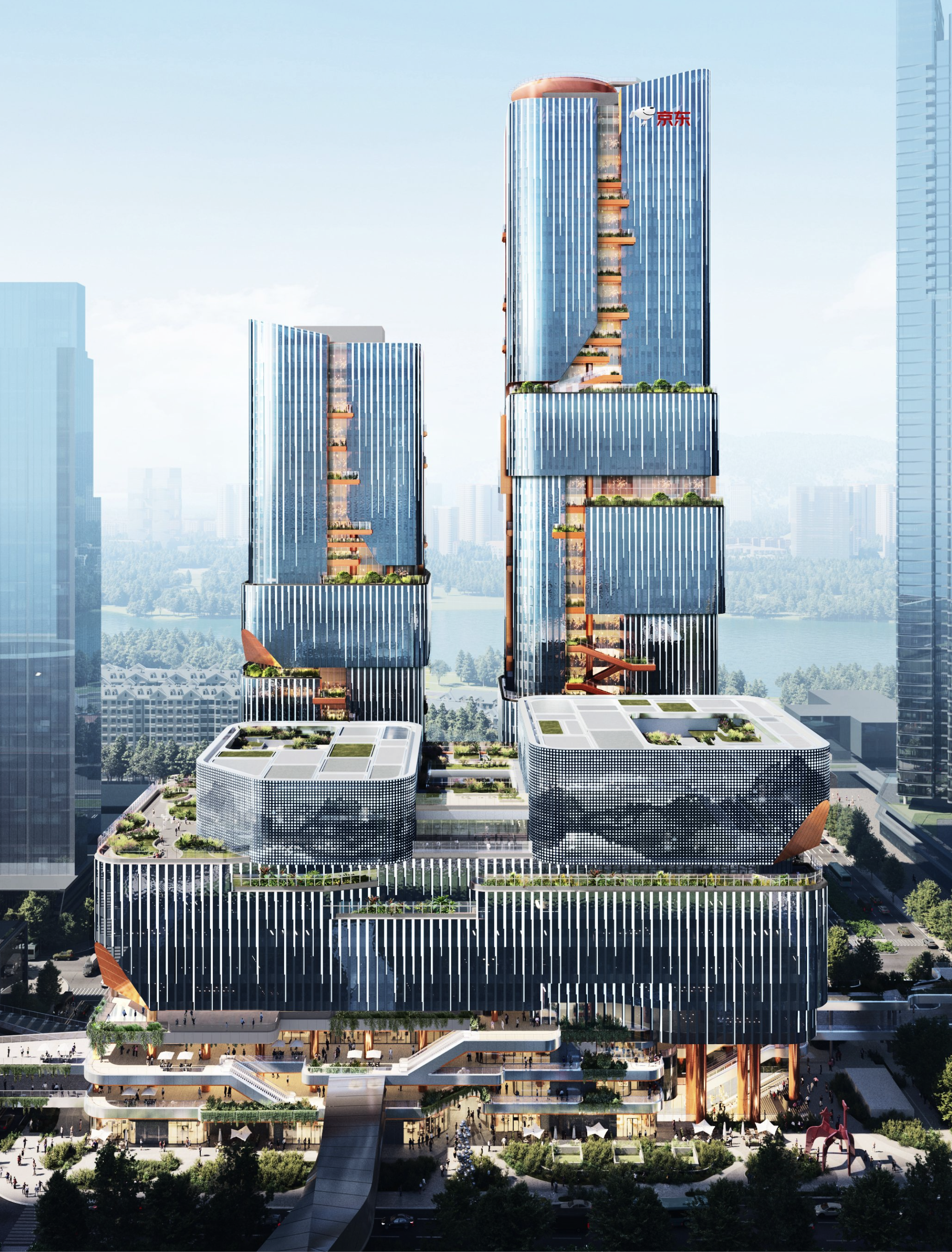
We’ll be in those two boxes on the top of that building’s podium, for the most part. I think this will be an exciting development for the Nostos project as a whole. The Museum will incorporate a large art bookstore with a dedicated children’s reading room (art books for children only!) where we’ll host regular events on art for families, and we’re working on a series of play-friendly commissions indoors and out.
It means that this newsletter will shift gears. At some stage we’ll most likely look to incorporate the Lives of the Artists interviews into the Museum’s publishing program. I’ll still save this space to share links and thoughts on the intersection of art and life here every Wednesday, but I’ll also be reflecting more on how I’m balancing the creative practice of planning this museum with my family life, with my relationships with my daughter and parents and brother and partner and friends.
For me and for all of us, this move means major changes. After seven years in Taiwan, which I would call unreservedly the happiest of my life, we’ll be moving to Shenzhen soon. My daughter will be switching to a new school in the summer between sixth and seventh grades (sorry for that), and I’m spending long days in the office. There’s a lot to be discussed and sorted out in the process of giving shape to a new organization, and sometimes unexpected situations need to be handled during the times when I otherwise might have been cooking for family and friends, or walking the dog.
I’ve had the pleasure of working through a management course consisting of lectures by Richard Liu, the founder of our parent company, JD.com. Understanding different corporate cultures and management principles is one of my secret intellectual pleasures. The Netflix culture deck, the Amazon memo system. I learned so much from my time in Thomas Shao’s Modern Media Group office, and turn often to concepts that he first brought to my attention. It’s not so much about productivity or copying directly from a certain company or industry for me. I love what these things have to say about ideology and the principles that we live by. JD.com is a company with almost a million employees, so it’s a whole other level of thinking about management and leadership.
I could share any number of learnings I’ve picked up so far. I love the “sit, stand, walk” principle: respectively, that’s showing up and working alongside your team; representing the organization to external stakeholders; and going out into the field; all forms of respect towards colleagues, partners, and audience.
But the one that really surprised me was the insistence that family comes before work. This is not something you expect to hear in the Chinese tech industry, which is famous for its long workdays and long workweeks. In this culture, commitment to the family goes without saying; commitment to the job is a form of educational work, in showing your children the importance of dedication and responsibility.
The principle that my teams have always followed is to handle the thing that must be handled in the moment. Pick up your kid from school when she’s sick, and pick up the phone on your way to bed when you have an idea you need to get across to someone on the other side of the world. When you work across timezones with creative people, it’s hard to set firm boundaries via the time on the clock. Time management becomes an internal practice. We all have to protect our reservoirs of energy, to give when we are able and to recover and stimulate ourselves when we need it.
This is likely to become a recurring theme here as we get into the logistics of how to balance it all. How close to the Museum do we want to live while it’s still under construction? Should we choose a less rigorous school if it means I can walk my daughter to class every morning on my way to the office? How much tolerance for kids dropping by the office in the afternoon should we build into our team culture?
There was a beautiful profile of Joachim Trier in the New Yorker a couple weeks back, which describes his interest in creating a familial working environment and ties these efforts to early inspirations drawn from visiting movie sets where his father was working.
“I want the set to be a nice place.”
His new film, Sentimental Value, is one that I’ve been thinking about in terms of the intersection of art and family since the synopsis hit the festivals—it tells the story of two sisters whose estranged film director father tries to repair and then replace his family through film. There seems to be an upwelling here this season: think of Chloe Zhao’s Hamnet, also, on art as a product of the sublimation of domestic life. But I haven’t gotten to see either of these yet.
The one I have seen, Noah Baumbach’s Jay Kelly, lands in a more sentimental corner of this psychological territory, ending on George Clooney with a tear in his eye as a phantasmagoric highlight reel of his art and life comes to a close. “Can I go again?” he asks, “I’d like another one.” And that is of course the drive that motivates creative practice in general, and what separates the proper area of sublimation from the life in which it is lived out. Yes, George, you can have another take. We can shoot the scene again. But you’ll be a little older in the next one, maybe a little more practiced and a little bit more numb. You can go again in life, too, sometimes (all the way until the end, anyway), but the rule is that you have to start where you are. You’re tormented by the missing memories of kids who you didn’t spend enough time with, and so in this next take you’re going to have to play across them as adults instead of children. But that’s okay. It’s still another take. Let’s go again.
There is a collage-like texture to Jay Kelly that I enjoyed quite a bit, a pastiche of references to films, actors, moments in the culture. “What is the fatal charm of Italy? I believe it is a certain permission to be human” (That’s lifted from Erica Jong, whose daughter Molly Jong-Fast published a memoir last year about life with a famous mother and her eventual dementia diagnosis). It’s a wink at the love of cinema for its own sake, no matter how big or unwieldy it gets. As an aside, you get that in Zootopia 2, too, with its excellent Succession cosplay, a little Mos Eisley reference, and—did I hallucinate this?—a Stitch monologue a the end. (I haven’t had a lot of time for cinema outings without my daughter recently, as you might guess.)
With all of the talk about AI hallucinations in the discourse, I catch myself wondering if things I latch onto are hallucinations or real things out there, somewhere, in the slipstream. I think that, psychologically, we are highly suggestible by the terms of the discourse. The way that things are reported and talked about gives us an internal vocabulary for how we feel. It doesn’t mean I’m any more likely to hallucinate connections than I used to be, but because it’s on my mind the pattern emerges more clearly. I noticed this back when we first started talking about the infinite scroll, that we taught ourselves to think in terms of surfaces and depths again in a way that had gone out of fashion.
Attention seems to be the thing that can anchor us to ourselves and others now. Katrina Lainsbury offers a diagram of how attention or what we choose to notice leads into the internal architecture of taste:
INPUT → EXPOSURE
         |
         v
 ATTENTION (What we notice)
         |
         v
 SELECTION (What we save)
         |
         v
REVISITATION (What returns)
         |
         v
PATTERN RECOGNITION (Emerging themes)
         |
         v
     TASTE (Internal architecture)
Recently I came across a really long Spotify playlist that purports to be based on James Baldwin’s record collection. It’s a lot of soul, gospel, R&B. Cozy music for winter working, not necessarily the sort that requires a lot of focused attention, but the kind that might bring a couple degrees of transcendence into a social living room.
I spent a lot of time when my daughter was away over the holiday thinking about an article by Eli Stark-Elster about the spaces children have to play today. The opening statistics are striking: more children my daughter’s age have interacted with a chatbot than have walked to a store alone. That’s crazy to me. That’s not how our family works: when the last block of feta disappears right before dinner, the offending snacker is walking to the store to get more feta. Given the way device culture in schools is evolving, I’ve decided that the best strategy is to integrate conversations about the digital spaces everyday in order to make them feel more real and consequential. Like Eli, I find myself hoping for better online spaces. No one expects absolute safety—there’s a risk in walking to the feta stand too, but that’s the friction that makes life worth living.

I would love to see this become a dark forest situation pioneered by digital art. Where are the creative, child-friendly sandboxes online? Where’s the next level on top of Roblox?

There are some things shifting in the digital art space. Feral File has relaunched separate from Bitmark. Outland has relaunched separate from its original parent organization under longtime editor Brian Droitcour. Maybe there’s some space for new projects to emerge here. I hope the framework we’re building in Shenzhen can play a role in seeding some of these experiments, too.
Until then, take the long way home.