

Icon: Ian Cheng
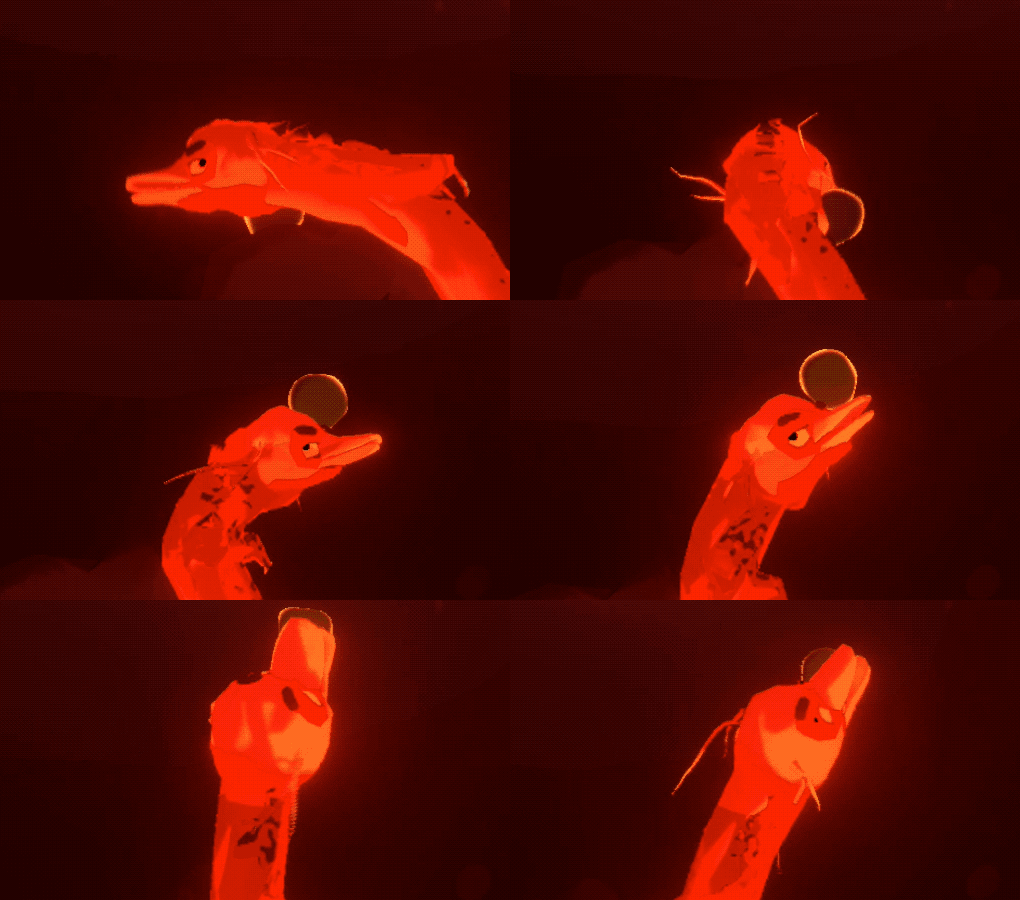
In New York earlier this month I had a phone call with Uncle Dragon, an avatar of the family-friendly AI known as SAGA developed by Ian Cheng’s Opponent Systems. I knew that Ian had been working on something around family and AI—I had assumed it was for children, and was surprised when he clarified that he started out developing it for kids before finding that it was actually the grandparents who spent the most time interacting with it. In my family we’ve had firsthand experience of children turning to chatbots to assuage their loneliness, so I can see how this could get interesting. Ian is particularly focused on how the dragon, who you chat with over Facetime, could become a repository for family lore, passing down networks and connections in a way that is palatable for everyone involved.
Ian is one of my favorite thinkers on parenting and technology in general. He’s done a lot of work with the idea of “worlding,” which is a big topic in digital art and gaming (as well as in marketing), but he’s also asking what it means to look at parenting as a form of world-making (“parenting is programming”). When intelligence is artificial and reality is virtual, growing up might mean passing through an increasingly consequential series of simulations. I love seeing creative people who treat the family environment as a laboratory for projects like this, and can’t wait to see where this project goes.
You can sign up to the waitlist for SAGA here.
Field Trip: Lucian Freud
My first stop in London was the Lucian Freud exhibition at the National Portrait Gallery, which brought together too many of his drawings and not enough of his paintings, albeit with a quirky selection of works that made the exercise rather fun. One of the best paintings, for my money, was his portrait of David Hockney. David also did a commensurate portrait of Lucian, though that unfortunately wasn’t in the show. As two artists we’ve looked at quite a bit through the Nostos lens, this pairing would have been a fun one to revisit.

There was a whole wall of works that alluded to Large Interior, W11 (after Watteau), the painting that we have looked at previously for its weird and exuberant depiction of Lucian’s highly unconventional family structure.
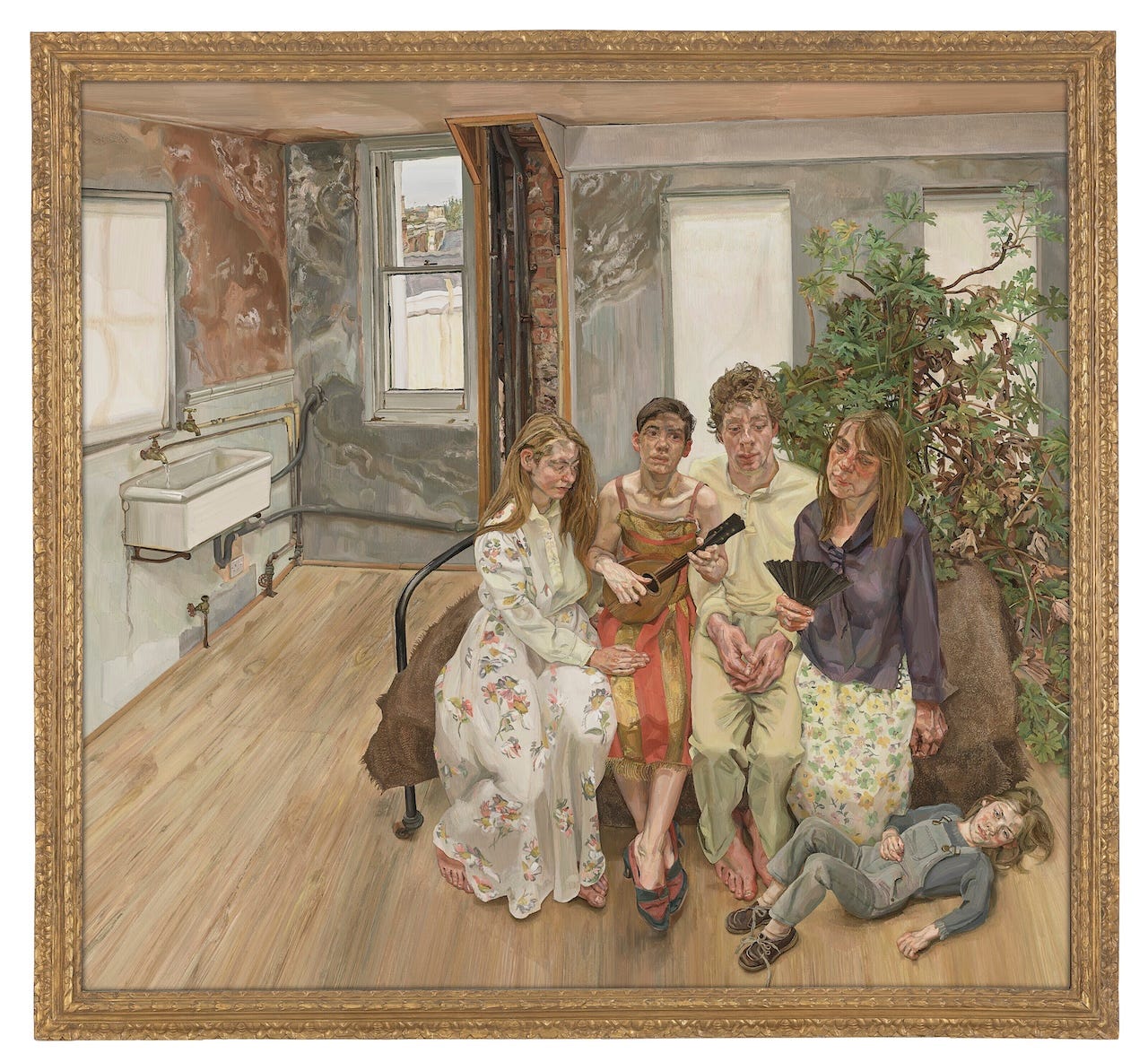
Here, it is nestled within a gallery dedicated to works inspired by the classics. By “it,” however, I don’t mean the actual painting—it was sadly absent. What we get instead is a series of preparatory compositional sketches, some of the most interesting drawings in the show. It looks to me that drawing was, for Freud, much more important as a way of thinking through space than as a tool for the close study of the sitter.


The NPG shared quite a bit of background on the project:
Lucian Freud said of Large Interior, W11 (after Watteau): “I took a while setting it up. It took quite a lot of staging. I’d been making drawings with the idea of doing a group painting, which I’d never done … It’s the nearest thing I have ever come to casting people rather than painting them, but they’re still portraits, really. They are also characters. A slight bit of role playing ... but I didn’t try to forget who they were. In the end they are just there.”
The artist gathered together people who were close to him to create the painting, which he regarded as ‘a family portrait of sorts’. Freud required the sitter to be present even when he was painting the background, aware of their impact on the space they occupied.
Sitting on the bed from left to right are Celia Paul, Bella Freud, Kai Boyt and his mother, Suzy Boyt with a girl called Star lying on the floor. The sitters only sat together as a group two or three times. They were also painted individually and sometimes with the person they sat next to. Celia Paul sometimes sat with Bella Freud and Suzy Boyt with her son Kai. Bella mostly sat for After Watteau alongside Celia and remembers the heat, which emanated from two bodies sitting so close together. Star, the little sister of the girlfriend of Freud’s son, Ali Boyt, was a stand-in for the original subject. Star was later described by Freud as “borrowed and bored.”
Poor Star. What I didn’t expect to capture my attention, however, was a wall of whippets. We learn that, in a certain scene at a certain moment in time, everyone had whippets. They are somehow the perfect dog for a draughtsman, all legs and angles. In some of Lucian’s compositions, a whippet curls up in the lap of or against the body of a man, tracing the architecture of affection.


Lucian sketched the head of one of his whippets, Pluto, for his daughter Bella’s brand. In one piece, she’s depicted wearing the Pluto jumper. There is also a Pluto shirt conveniently available in the adjoining gift shop, but it’s not the same graphic. Next month, Christies will sell Pluto’s Grave, a ridiculously sad painting.
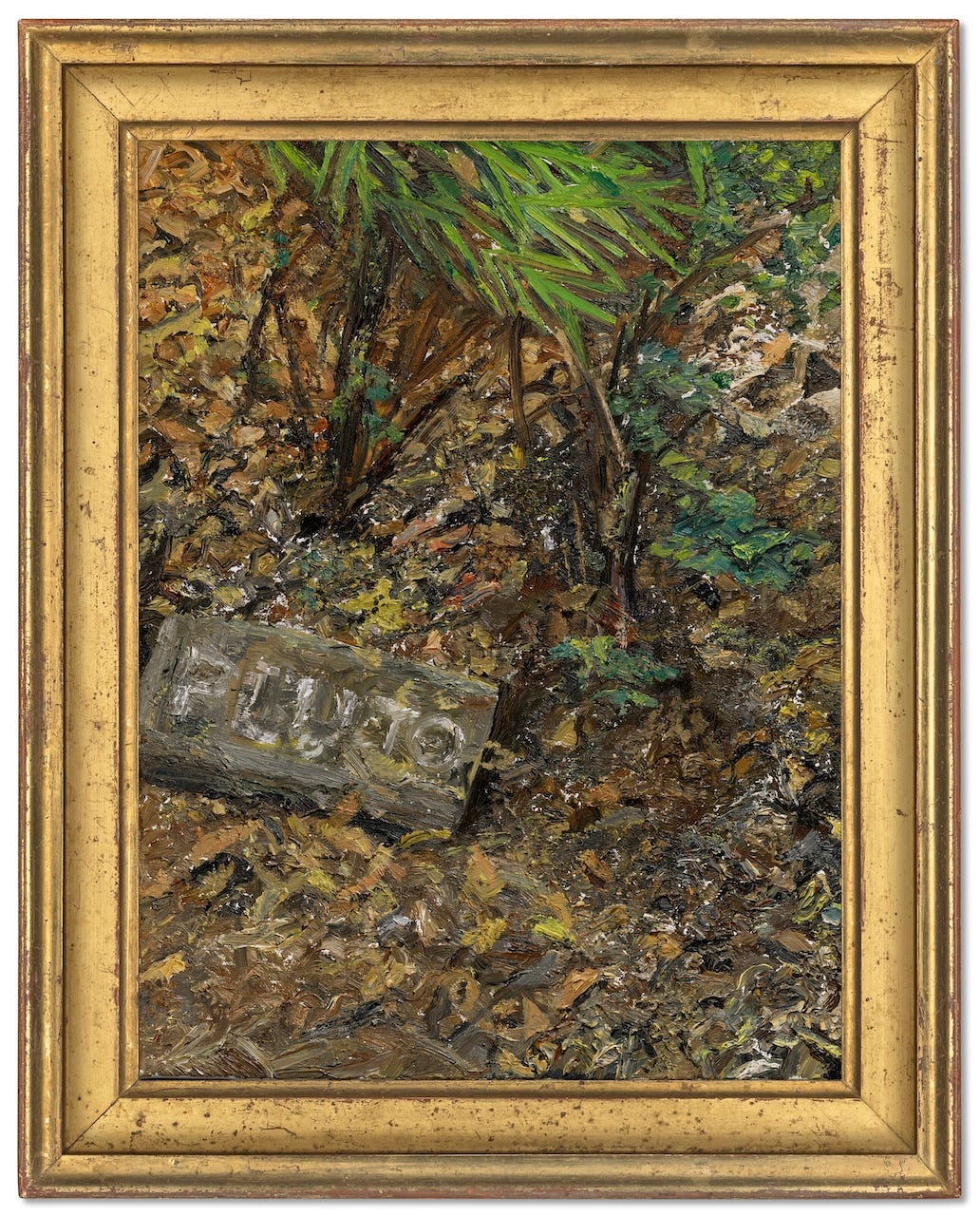
The catalogue note for the piece reads like poetry:
Painted in 2003

Provenance:
The Artist.
Bella Freud, London.
The Artist.
Acquired from the above by the present owner in 2004.
Pluto’s Grave changed hands between father and daughter twice in the year after it was completed. For money, for love, or because it was just too sad to hang at home?
Projections: Petite Maman
On my second-to-last flight over the weekend, from London to Hong Kong, I had a chance to catch up on a few movies I had been meaning to see. One of them, Petite Maman, was a perfect Nostos piece: a little girl of eight years old, accompanying her mother to clear out the old family home in the wake of her grandmother’s passing, runs into her doppelganger in the woods behind the house. This turns out to be her mother at the same age. They spend a couple days together, building a fort in the woods, eating their mother/grandmother’s mediocre cooking, playing board games, and acting in a play. Everyone—the girls, present-father, past-grandmother—seems to have a tacit understanding of what is happening. The girl and her mother-sister-friend are played by twins. (As opposed to the CGI of the twins in Sinners, which I also finally watched on this flight. Where there is a darkness to the doubling of Michael B. Jordan’s twins, and an inbuilt figure of two forking paths, in the cross-generational twinning of Petite Maman there is hardly a suggestion of the uncanny. Everything occurs as it must, the crossing between life and death a gentle brushing through time rather than a piercing of the veil.)
Petite Maman was Céline Sciamma’s follow up to Portrait of a Lady on Fire, another contemporary classic and another meta-object about the relationship of art to life. In that period romance, a painter and her would-be patron, a young woman due to be married against her will, fall in love over the course of a contested portrait. Their affair persists through the formal wedding portrait, through another secret nude, through an additional portrait painted by a third party, and finally through a piece of music that follows them throughout their lives. Art is where love persists, even when life does not permit it.
I found both movies incredibly moving on their own distinct wavelengths. In both the present is remade through fragments of the past, and in both the motivations of the other must remain necessarily opaque. In Petite Maman there is a scene where the girl accuses her father of never telling her what it was really like when he was a child, of only sharing superficial details. It is difficult for us to remember, sometimes, what else there was beyond the details, because the fears and anxieties and pains of childhood can feel so small and remote from here. As often as we wonder at the joys of experiencing the world anew through our children’s eyes, how often do we wish we could meet them on their own level? As much as I hope my daughter can benefit from everything I’ve learned between then and now, do I ever wish that she could see what I was like when I was her age?
A couple weeks ago, waiting in line at a restaurant near my office in Shenzhen, my daughter and I had a big, emotional fight. She was asking for more pets (we already have two), thinking that they would keep her from being lonely at home. I tried to convince her that this was an illusion; that we can feel lonely even when we are with other people, and that she will need to learn to sit with that void and those unpleasant emotions rather than seeking to push them down with company, with distraction, or with material things. Through her tears she resisted, “I’m eleven! How am I supposed to have the emotional bandwidth for that?” There is a lot of childhood loneliness in Petite Maman, and I suspect that encountering a twin is the secret fantasy of many an only child. In a way I suppose it is incumbent upon us to become that twin and see the world through those eyes, if only for a moment—for the length of a movie, every now and again.