
Icon: Charlie Roberts
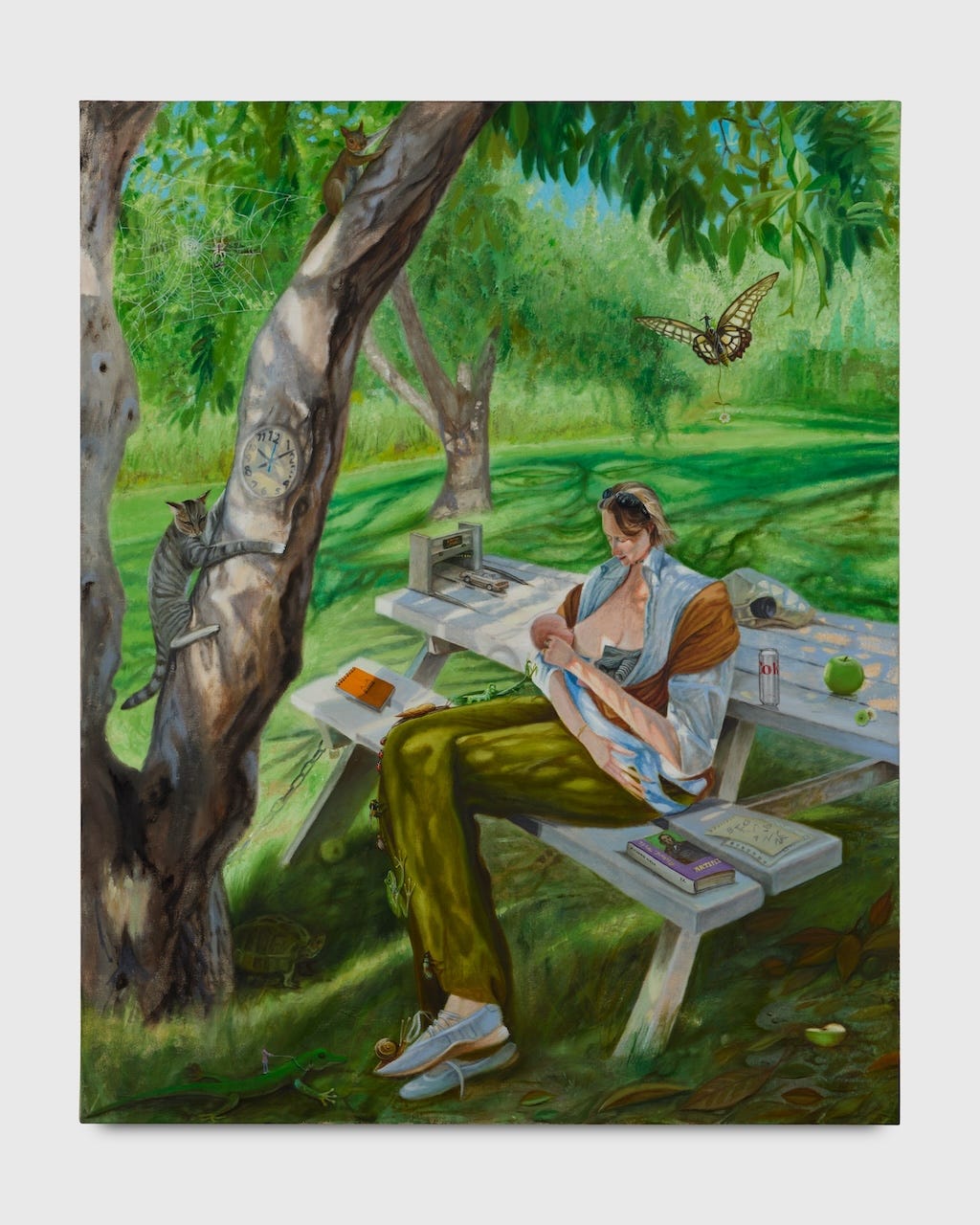
I really appreciate Charlie Roberts as a painter. I love how contemporary he is, how everything lands in the painting, how it feels like such a creature of its moment, and not only the era or the decade but the year, the month, the season. And I love how classical he is, how traditional this particular picture is, how it doesn’t shy away from the sacred aura of the painter’s view of motherhood or the memento mori of time passing by, decay surrounded by new growth. I love how little tension there is between these two aspects of his position. Whereas in many painters working in this genre there is meant to be a moment of pearl-clutching, a gasp of shock at the idea that he/she dared to do something profane so classically (Currin, Condo, Yuskavage), here there is a more modest recognition that art lives in time. There is a nice text on the painting here.
Field Trip: Zak Kitnick
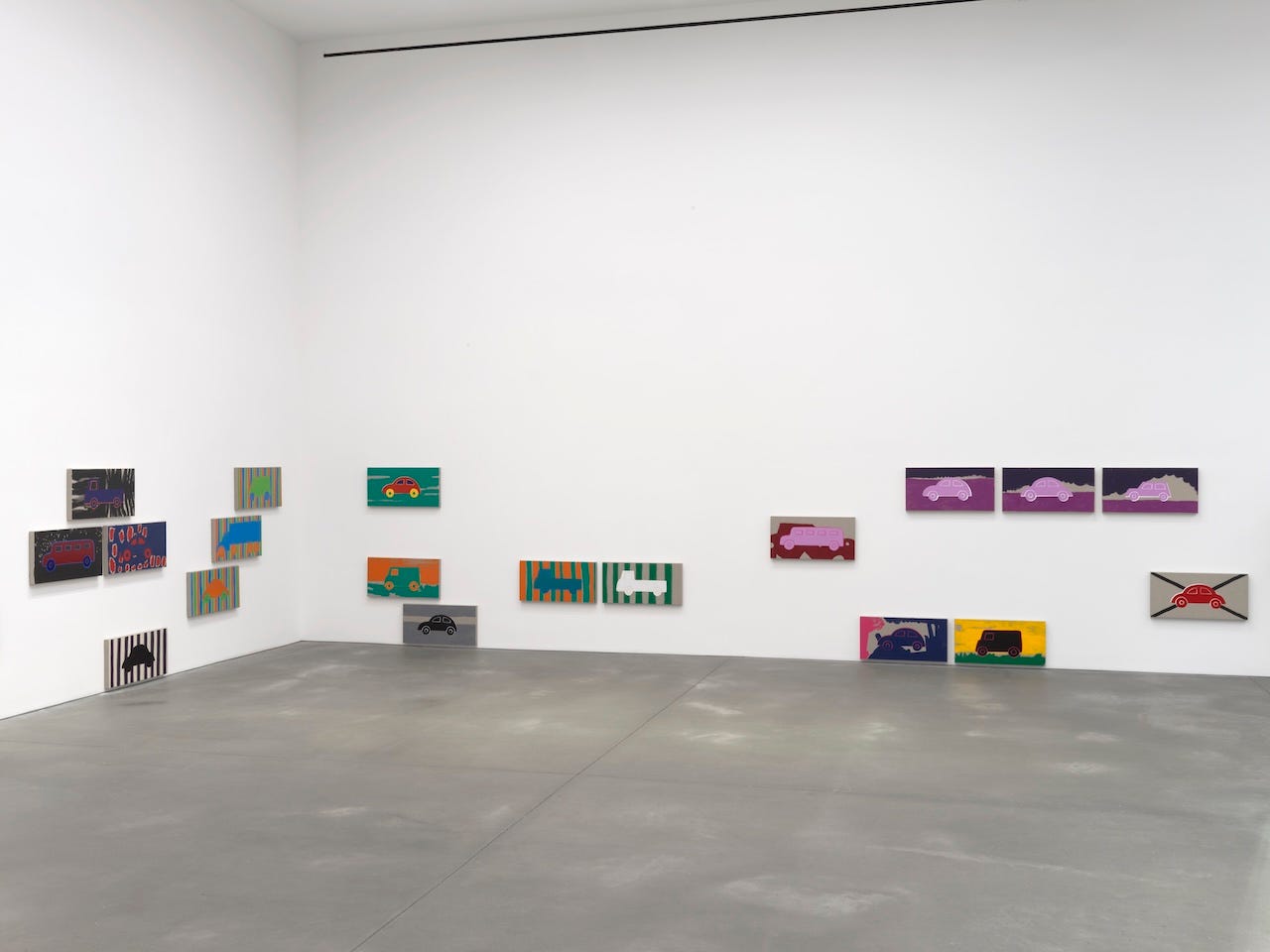
Zak Kitnick, whose work has so much been about seriality and repetition as the underlying structure of painting, has found a new conceit as a new father, evident in his exhibition “Paintings for Children.” He’s made more than 100 paintings of cars, trucks, and things that go, recognizable and consistent forms drawn from bedsheets that he remembers from his childhood. They’re hung in the gallery in several different bands, all at heights where they’re easier to see for children than for taller adults.
The project is most directly in dialogue with Andy Warhol’s “Toy Paintings,” paintings and silkscreen prints of toys and toy packaging that he made in the early 1980s and showed first in Switzerland with Bruno Bischofberger (where adults unaccompanied by children were charged admission) and later in the US at the Newport Art Museum, where they, too, were hung at several bands as low as three feet off the floor. Some of Warhol’s compositions were as rote and simplistic as Zak’s, but others were formally sophisticated, and many of his toys came from specific regional contexts; the toy was a cultural avatar of capitalism, universalizing but never truly universal. Zak sublimates compositional complexity into the painterly brushwork behind his icons, creating a space for painting around and in support of the stated aim and audience.

Warhol made 128 paintings in the series, at least 86 of which it seems have made it into the Mugrabi holdings, and in the 1980s exhibitions they were hung on a wallpaper stamped with a fish pattern. In one room of Nino Mier, Zak has also made a stamped wallpaper, a sentimental nod to the love that has to suffuse a project like this as well as a wink at the back-and-forth of repetition and difference between print and painting.
Most humanely, the show opened with two daytime sessions of popcorn, cotton candy, and coloring. You can read more about Zak’s show here.
Projections: Hamnet and Sentimental Value
I was talking around Sentimental Value for nearly a year, since its entry to Cannes last May, before I was able to finally see it at the cinema. A couple months ago I linked to a profile of director Joachim Trier, who “want[s] the set to be a nice place” because he has such positive childhood memories of visiting the film shoots that his father was working on. I quoted Chloe Zhao in the same post, whose “dance takes” on the set of Hamnet went viral as a way to achieve the emotional catharsis necessary to reset when dealing with such heady, heavy subject matter, especially with child actors playing such integral and dark roles.
I ended that post on Noah Baumbach’s Jay Kelly, primarily because it came straight to streaming while I was still waiting for the highbrow stuff to find its way to our local arthouse, on George Clooney reviewing the highlight reel of his life and asking if he could possibly have another take, another go at the whole thing. Oddly enough, that’s exactly where I want to pick up today, because all three of these movies end with the same scene: a film scene is taken or mistaken for reality, emotional knots are loosened through acting, and the perceived line between art and life is erased and redrawn in a protective circle. In all three movies, the central absence is the father who is drawn away from the family by creative pursuits. This is handled sensitively in all three cases: even narcissistic chauvinism is shown to be a deeply held insecurity.
I suspect that filmmakers—like artists, like writers—are prone to romanticize the work that pulls them from their families, and I suspect that the urge that pulls them there, the urge to make something and be something to the world, is not so different from the urges that keep men working long hours focused on their careers outside the home in business and engineering and whatever else. But what we see in the practices of people like Zhao and Trier is that there remains a possibility to make the process of this urge inclusive of the things that would otherwise sit alienated outside of the practice. The accountant, the lawyer, the consultant can’t easily involve the wife and kids with their overtime and business travel, but the painter, curator, and designer can and sometimes do.
The artist can make hurtful personal decisions, then sublimate them into art so great that it becomes capable of healing the damage caused by those same personal decisions. The artist can also make loving personal decisions, and cultivate them into art capable of transcending circumstance. There’s a certain irony to artists of the latter category, like Zhao and Trier, writing their apologies for artists of the former—but perhaps that’s the slippage. Perhaps anyone dedicated to the craft at that level is pulled towards the former, and pulled with at least enough gravity that they feel there is something to apologize for—at least on the level of principle.
In Sentimental Value, Trier tells the story of an accomplished cultural family via the metaphor of their old-fashioned wooden home in Oslo. We meet three core members: Nora, a theater actress with crippling stage anxiety even as her career is accelerating; Agnes, her younger sister who offers a benchmark for a healthy and normative family life; and Gustav, their father, a successful film director who has been an inconstant presence in the family home since his divorce. Sensing that Nora’s rising star could rescue his flagging ability to locate funding, Gustav clumsily hands her a script that she refuses point blank. Frustrated, he secures funding and notoriety by casting an American ingenue in her place. The catch is that the film is shot on location in the family home, and that Gustav’s script is actually intended as an apology to Nora, communicating with her through the only language he possesses. As all of this becomes clear—he asks the blonde ingenue to dye her hair, and she puts on a ridiculous accent before bowing out of the production—Nora is inexorably called into the role, but it is eventually shot on a soundstage reconstruction of the house.
That’s the broad arc of the piece, the one that is held universally across these three movies: art heals the wounds it creates.
For me it was two smaller trajectories within this arc that brought the whole thing home. The first begins in a funny moment early on. Speaking on stage for a Q&A at a film festival retrospective of his work, Gustav is asked about the relationship between cast and family. He spouts a canned line about how the cast and crew are his family (a nod to Trier’s own position), only for the interviewer to remind him that that’s especially true in the film they were discussing, because it starred his younger daughter, Agnes, as a child. He seems caught off guard. Agnes got her acting out of the way early and never felt the need to return to it. This also leads her to be circumspect when Gustav seeks to cast her son, his grandson, in the film, in a role that stands in in some ways for Gustav as a child. Eventually, after she convinces Nora to take her role, Agnes relents, and the movie closes with Nora embracing her nephew in the reconstruction of their home.
And it’s this home and its reconstruction that marks the tightest, most beautiful little orbit within the film for me. The montage sequences that convey the family’s history with this structure are heartrendingly beautiful, the ghosts of generations compressed into a single share space, all of them shot as if they could be living today, all of them present alongside the living that we are coming to know: the secrets, the little rituals, the parties, the asymmetric crack in the foundation. In this way it is not so different from Sound of Falling, which interweaves the tragic stories of four generations of a German family farm across the arc of the long twentieth century, or even Saltburn, in which an English estate stands in for an entire class structure but also takes on more characterization than anyone in the cast. Place has memory. Anyone who has experienced the mixed blessings of a generational family home can attest to that.
In Hamnet, Zhao adapts the biography of William Shakespeare and tells the story of his family life in the making of the play Hamlet. We meet William as the teenage son of a glover falling in love with Agnes, the witchy black sheep of a local family, and follow their courtship, marriage, and parenthood. Like Gustav, William spends most of his time working, writing late into the night in all-consuming states of mind and eventually moving to London to pursue the theater. Agnes is generous and supportive of his dream even as resentment at William’s absence accumulates over time, coming to a head when he fails to be present as their son, Hamnet, dies of the plague. An abyss opens up between them until she followed him to London and witnesses the premier of Hamlet, which channels and sublimates their grief and—potentially—offers them a way to live with it together.
Art heals the wounds it creates.
Zhao is a brilliant director and, like Trier, manages to create a really special alchemy among her casts, which the “dance takes” can only gesture at vaguely. So much of Hamnet is about acting as acting: acting our a role means taking an action. The word “agentic” has come to mean something very specific in the last couple of years, but I want to use it in a slightly more traditional sense, without the Silicon Valley ideological hue it has taken on. Acting-as-if. Pretending is a form of agency. Both Paul Mescal as William and Jessie Buckley as Agnes are handed scenes that require intense psychological authenticity and subtlety, Paul in his endgame monologue on the London stage and Jessie in her birth scene (and death scene). We get elegant speechifying and guttural animality all in one place, as if life could indeed be sublimated into art.
That birth scene leads me to the last point I want to make about the movie, which is the qualities it takes on from the landscape film. The deep countryside plays an important role in the formation of Agnes as a character, giving a shape to her witchiness and knowledges of the land, but it also sets their family off from the world, bracketing it in an unpeople Eden in which the only dynamic that is real is the one that emerges between them—the one that splinters when William needs to further his practice in the city. Art is the forbidden fruit, the knowledge of good and evil that opens the gates of paradise out into the world beyond.
I won’t repeat my gloss of Jay Kelly (it was in a January post here if you’re interested), except to note what a cold comfort these movies have to offer for the children of creatives: if your parents are too busy in the studio, don’t worry; one day you’ll connect with them through their work. Or, alternately: perhaps you’re one of the lucky ones, and you’re in the studio with them right now.